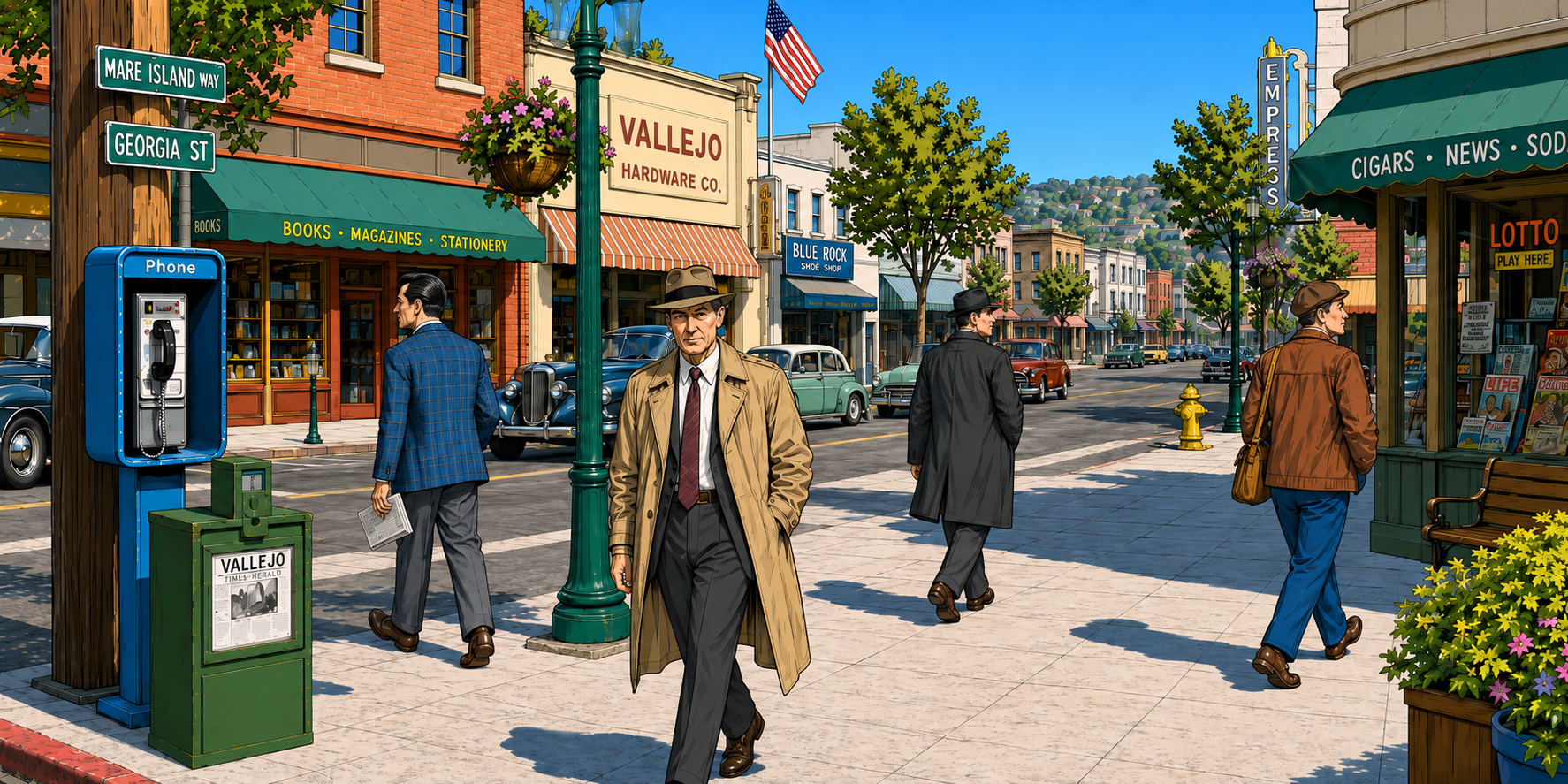
(Thank you for reading! I Just needed a break from politics. Hope this sheds light!)
Attempts to determine the identity of the perpetrator in the Zodiac case often begin by framing it as a story of a criminal so clever that he outpaced the tools of his era and vanished by force of intellect alone. That explanation has always been unsatisfying. A more grounded reading starts elsewhere—not with what did happen, but with what did not.
No authenticated archives were discovered. No notebooks ever surfaced. No practice sheets appeared. No private library of symbols, codes, or drafts ever emerged.
And the perpetrator himself did not reappear, anywhere, in any form that counts, after 1974.
All of these things that did not happen offer a way to narrow the field—to move toward the shortest list of possible names for who the killer might be.
The starting point is not psychology. It is in after-effects. Begin with what the offender demonstrably produced. In the surviving letters alone sent to newspapers the Zodiac drew by hand at least 793 cipher characters - 408 in the Z408, 340 in the Z340, 13 in the Z13, and 32 in the Z32, plus additional symbols and diagramming in the surrounding letters and cards.
These were not casual marks. They required reference, practice, false starts. No one reliably produces that volume of symbolic material from memory alone. Such work presupposes source materials and rehearsal: pages of trial and error, discarded drafts, and reference texts kept at hand.
The ciphering and symbols allow us to bracket his formative years. The first clue to who he might be, or where we can find evidence of him.
Letter-substitution codes, symbol alphabets, and rotating decoder wheels were standard features of mid-century American youth instruction and hobby culture. The technique is mechanical: write a message in normal letters, then replace each letter with a mark from a lookup key. For example, if the key says A = △, B = □, C = +, then the word CAB becomes + △ □. A decoder wheel does the same job with two printed alphabets on rotating disks: you set a starting position, then write each letter as its shifted partner.
The Zodiac’s cipher writing operates in that same register. The symbol inventory is dominated by basic geometric and typographical forms - circles, crosshairs, plus signs, triangles, squares, short strokes, and punctuation-like marks—exactly the kind of marks that recur in youth code pages because they are easy to draw consistently and hard to misread. The structure aligns as well: a mark stands in for a letter, and some common letters are given more than one mark so the text does not repeat in an obvious pattern.
That combination points to a specific life stage. People do not typically acquire this style of symbol-alphabet writing in middle age; they acquire it when the culture hands it to them—through youth books, clubs, and instruction. If the Zodiac is using it fluently in 1969, the most direct inference is that his formative exposure falls in the 1940s through the early 1960s. That places him, when the crimes begin, most plausibly in the late teens through early thirties.
What distinguishes him is not that he once learned these systems, but that he stayed with them and brought them forward unchanged. He did not treat the codes as a one-off stunt; he returned to them as a recurring instrument of control—deciding who can read, when the public must wait, and how much effort must be spent to reach him. That persistence is not compatible with vague childhood reverie. It implies retained reference material: manuals, copied tables, notes, or practice sheets. In other words, he kept those works as seeming reference materials for a world he would rather live in - and he used them repeatedly, as a private toolkit that anchored his identity and his method.
Yet none of these kept tools have ever appeared over the ensuing years.
Such held materials have a way of resurfacing. They turn up in places everyone recognizes: a cardboard box pulled from a closet, a paper sack at a garage sale, a banker’s box under a folding table in the shade of a driveway sale. Old notebooks get flipped through. Loose pages are thumbed. Dog-eared manuals sit among mismatched paperbacks. This is how parts of private lives re-enter the world.
None of that happens here. No notebooks resurface. No manuals drift into circulation. No stray pages appear in flea markets, secondhand shops, or estate clearances. For someone who produced this volume of symbolic work, the silence of the ordinary afterlife of possessions is the anomaly. Writers leave things behind. Symbol-makers leave even more.
That disappearance is not limited to objects. The offender himself vanishes. After 1974, nothing. There is no relocation. No re-emergence in Dallas. In Philadelphia. In Minnetonka, or any other city under a new name and the using same perverse calling card. There are no analogous crimes, no new taunting letters to different regional powerhouse - and unusually local - newspapers, no attempts to perpetuate the persona. Everything simply ceases. The generally accepted corpus of evidence stops at 1974.
For someone so determined to seize public attention, the categorical evaporation makes no sense. By 1974, through a half-decade horrific chain of violence and human indifference - 7 victims, 5 deaths, at least 13 threats to society mailed to newspapers - the Zodiac had crowbar-ed himself into national public consciousness. He forced the Bay Area’s largest newspaper to serve as his conduit, demanding and receiving prominent publication of his cipher and threats. He kept police, editors, and readers in a roiling state of anxiety, and the case was vivid enough that when a caller claiming to be the Zodiac phoned a live television broadcast with host Jim Dunbar and attorney Melvin Belli, he was put on the air - an episode so well known it remains a fixed landmark in the story.
That level of notoriety mattered - but not because it rewarded the violence. Because, by the time that identity reaches the point of acting out, it has already been shaped by attrition rather than choice. A sequence of rebukes, failures, and uncorrected humiliations has narrowed his inner life to grievance, until resentment becomes the only stable orientation left. What arrives is not a blank slate waiting to be seen, but a hardened posture, carried intact into isolation.
And then, the notoriety. The identity exists privately until it is exposed. Once seen - however obscene the exposure - the mere fact of visibility, with attention being paid, is sufficient to sustain repetition. The acts continue not because they work, but because they are no longer solitary.
Voluntary cessation is unlikely. Stopping would require more than restraint; it would require dismantling the posture that has come to organize his inner life.
We can clearly infer that being this monster occupied all of his non-working hours. As we can infer other things, from his case, and those who have repeated such crimes over the years. Then, finally, from his age - late teens to mid-twenties to mid-thirties - we can infer much more. The footprint he leaves in the snow. Unaware.
He is far more likely to have been a loner by circumstance and temperament, but not an idle one. He would have found steady employment, yet the kind of work that leaves nothing behind at the job itself. Blue jeans labor. Hands on, tool based work. A trade or site job where you show up, do the work, and leave with what you brought. Roofing, perhaps.
Such a life produces little outward record. No office, no desk, no drawer of papers to be inventoried. No colleagues handling personal effects. No supervisor boxing up a workspace. Everything you own stays in your rented room.
And socially, such a person is often estranged rather than merely solitary. No spouse. No children. Few, if any, close friends. No one waiting to claim boxes when the lease is broken. Or, when it stops being paid. Or, even to notice you’re not there, or not coming out.
And, for an entire symbolic archive such as what must have accompanied the hand-written production of nearly 800 ciphers over at least 13 mailed letters, for every scrap of that to simply disappear, the work space must satisfy strict constraints. It must be occupied alone. It must lack family members, spouses, or adult children who would sort, save, or question what they found. And, it must be rented. Rented rather than owned. Only a rental explains the evaporation of all the expected physical evidence. A rental abandoned due to non-payment.
Cleared quickly, by people whose task is disposal, not interpretation.
Indifferent disposal of all the contents of a rented room in a single day. Followed fast by quick next-day whitewashing to speed turnover. And, this is the key clue that leads us to a concrete list of potential suspects.
If we take these constraints seriously - a renter who retained adolescent cipher systems into early adulthood, who produced an extraordinary private archive and yet left no trace of it behind, and is unlikely to have lived inside dense social networks – if we focus on this, a picture begins to slowly come into focus rather than leap into view
This matters because the psychology implied by the crimes-public boasting, symbolic exhibitionism, controlled violence-requires both isolation and structure. Enough solitude to cultivate lurid fantasies uninterrupted, enough routine to sustain it over years. A rented room supplies both. It is small, controlled, and entirely private. It becomes the whole interior world.
With this, the end state follows, and the vanishing of not just the person but every single scrap of his after effects makes perfect sense - and points the best way for us to identify who he probably was.
Given that we assume he was employed in such a way as to let him arrive to do a task and then leave wholly self contained - speeding back to his solitary cell - in-cel before cel, but surely the celibacy was there - speeding back to his burrow on this day, perhaps on a motorcycle, something happens. A center line is crossed. A turtle on the road...
When such a person dies suddenly, the response is procedural, not personal. The calendar advances whether anyone cares or not. Day six. Day fifteen. Day thirty-two. Rent goes unpaid. A note is taped to a door, or isn’t. A landlord waits briefly, or not at all, and does what small landlords have always done when rent stops arriving. The room is opened. Whatever is inside is treated as abandoned property. Papers are thrown out with the rest.
Everything in the room is treated alike, because there is no one present to argue for distinction. Perhaps the cleaning crew spoke no English. The notebooks are not notebooks; they are trash. The symbols - if the notebooks are ever even opened - are not symbols; they are doodles. The worn manuals are not books; they are weight. Bags are filled. The contents are removed in bulk, sometimes with irritation, sometimes with contemptuous curses muttered, always with indifference - to the dumpster.
Anyone reading can understand the setting. A door banged on. A posted notice flapping loose. A stranger deciding what stays and what goes. If your own life were reduced to a single room, and you did not answer, the same switches would flip. The same bin would be filled. The same erasure would occur.
That mechanism does more than explain disappearance; it narrows the field.
Only a small class of lives end this way: single men, living alone, renting, estranged, dying suddenly, leaving no one to intervene.
In a city the size of Vallejo in the mid 1970s, those cases are few. They appear in coroner logs, in landlord complaints, in county burial records. They linger, sometimes, even in memory.
Within that handful of records, the mystery collapses from myth to name. Not hidden in code, not buried in genius, but written plainly in the clearest script - an unclaimed death in 1974 of an unmarried man under forty in Vallejo, California.
Stop the timeline at July 1969. After only the first two attacks. Look what repeats.
The first two crimes happen in the Vallejo area.
After the second attack, a call is made from the payphone at Springs Road and Tuolumne Street in Vallejo to… the Vallejo Police Department.
Then the mail arrives and repeats Vallejo again. The 408 cipher is split into three parts and mailed to three newspapers: the San Francisco Chronicle, the San Francisco Examiner, and… the Vallejo Times-Herald. San Francisco is the obvious place to send material for a large audience. The Vallejo Times-Herald is the choice that narrows the focus back to Vallejo.
Put the pieces side by side and the early pattern is plain. The first phase sits around Vallejo. The call is placed from Vallejo. The local newspaper selected alongside two San Francisco papers is the Vallejo Times-Herald. Vallejo shows up as the operating area, the phone location, and the local audience.
After that, later crimes do not require a new home base. And, if anything, indicate a person leaving FROM Vallejo, in a fugue we can imagine, driving in a straight line, and then in a straight line back again.
Lake Berryessa - Northbound travel runs from Vallejo into Napa on State Route 29, passing through American Canyon. From the Napa area, the common southern approach toward Lake Berryessa follows State Route 121 and the Monticello Road corridor. The same roads allow the return: Lake Berryessa back to Napa, Napa back through American Canyon, American Canyon back to Vallejo.
Southbound travel is just as direct. Interstate 80 runs through Vallejo and carries travel across the Bay Bridge into San Francisco. Interstate 80 also provides the return: San Francisco back across the Bay Bridge, back through Interstate 80, back into Vallejo. The map makes both directions workable as out-and-back trips rather than a move.
The dates fit the same practical picture. Lake Herman Road occurred on Friday, December 20, 1968. Blue Rock Springs occurred late on Friday, July 4, 1969, continuing into the early minutes of Saturday, July 5, 1969. Lake Berryessa occurred on Saturday, September 27, 1969. Presidio Heights occurred on Saturday, October 11, 1969. The cluster is late-week nights. Late-week nights are when a person can leave, drive a corridor, and still return to weekday routines.
But, then, in 1974, everything stops. For years people have tried to find the culprit by pinning the crime on the living – a parade of unlucky, hapless suspects.
They looked odd. Lived odd lives, and may have been - truly - odd.
But, being odd ain’t no way to find killers.
Recall, Christopher Jefferies, the UK landlord and retired schoolteacher whose individuality was mistaken for menace, allowing tabloids to invent a murderer before the facts had even arrived.
The clues all point to Vallejo: a male renter, unmarried, who dies in 1974 - unexpectedly and young. Under forty. Most likely in an accident. Get that list - it’s your strongest set of possible perpetrators.
Among the dates, the mailings listed below are the ones that are publicly authenticated or have entered the evidentiary record, and that bear directly on the structural constraints at issue.
Lake Herman Road, Benicia (December 20, 1968)
Two people shot and killed, and no phone call is reported.
---
Blue Rock Springs, Vallejo (July 4, 1969)
Two people shot, one died, and a call was later made to the Vallejo Police Department from the Springs Road & Tuolumne Street payphone in Vallejo.
On July 31, 1969, a handwritten letter was mailed to the San Francisco Chronicle with one-third of the 408 cipher, and the envelope was San Francisco postmarked.
On July 31, 1969, a handwritten letter was mailed to the San Francisco Examiner with one-third of the 408 cipher, and the envelope was San Francisco postmarked.
On July 31, 1969, a handwritten letter was mailed to the Vallejo Times-Herald with one-third of the 408 cipher, and the envelope was San Francisco postmarked.
On August 4, 1969, the “This is the Zodiac Speaking” letter was mailed to the San Francisco Examiner.
Lake Berryessa, Napa (September 27, 1969)
Two people were stabbed, one died, and a phone call is placed directly to the Napa Sheriff’s Department from a payphone in Napa—dialing the department’s number rather than any emergency relay.
Presidio Heights, San Francisco (October 11, 1969)
One person shot and killed, and no phone call is reported.
On October 13, 1969, a letter was mailed to the San Francisco Chronicle enclosing a piece of Paul Stine’s shirt.
On November 8, 1969, a mailing to the San Francisco Chronicle included the Z340 cipher.
On November 8, 1969, a mailing to the San Francisco Chronicle included the “Dripping Pen” card.
On November 9, 1969, the “Bus Bomb” letter was mailed to the San Francisco Chronicle.
On December 20, 1969, the “Melvin Belli” letter was mailed to Melvin Belli.
On April 20, 1970, the “My Name Is...” letter with the Z13 cipher was mailed to the San Francisco Chronicle.
On March 13, 1971, the Los Angeles Times letter was mailed and was Pleasanton postmarked.
On January 29, 1974, the “Exorcist” letter was mailed.
Lake Herman Road (Benicia, California) - December 20, 1968: David Arthur Faraday (male, 17, high school student) and Betty Lou Jensen (female, 16, high school student), dating (a young couple), both shot and killed.
Blue Rock Springs (Vallejo, California) - July 4, 1969: Darlene Elizabeth Ferrin (female, 22, restaurant worker/waitress) and Michael Renault Mageau (male, 19, laborer), acquaintances / on a date that night, both shot; Ferrin died, Mageau survived.
Lake Berryessa (Napa County, California) - September 27, 1969: Cecelia Ann Shepard (female, 22, college student) and Bryan Calvin Hartnell (male, 20, college student), friends (not a couple), both stabbed; Shepard died, Hartnell survived.
Presidio Heights (San Francisco, California) - October 11, 1969: Paul Lee Stine (male, 29, taxi driver), alone (no companion victim), shot and killed.
Thanks for reading.
Entoraliten traces the old patterns of power, fear, corruption, and conscience into the crises of the present - helping readers see today's politics through the long memory of civilization.
For comments, corrections, tips, or collaboration: entoraliten@gmail.com